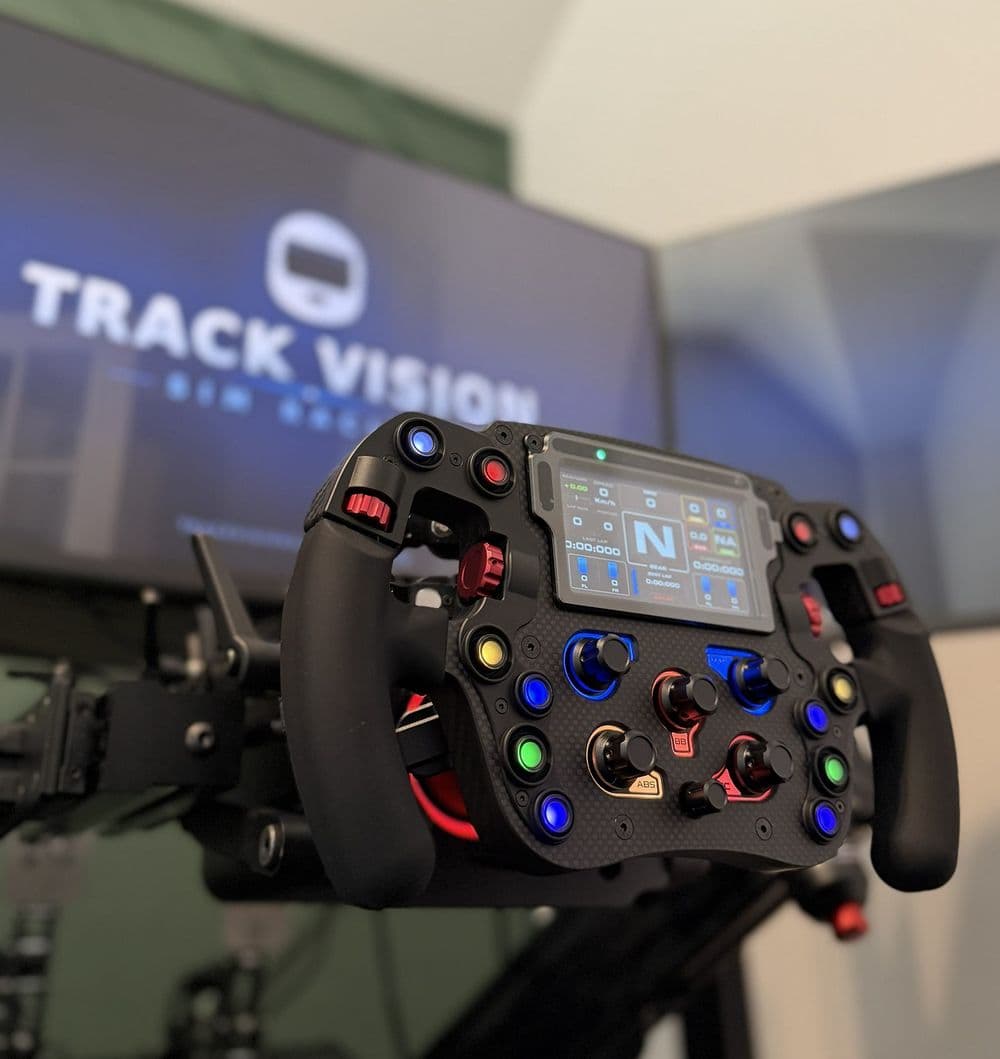
Torque is the number everyone shops on and the one that matters least. Here is how to pick a wheelbase by how you actually race, with current prices and the specs that change how the car feels.
The wheelbase is the one part of a simulator you hold in your hands for the entire session. It is where the tire model reaches you, where you feel the front axle let go, and where you catch the slide or do not. Get it right and everything else in the rig gets easier to use. Get it wrong and you spend two years upgrading through three of them.
The trouble is that wheelbases are marketed on a single number. Every brand leads with newton meters, every comparison video ranks by newton meters, and the result is a lot of people buying 21Nm bases and then running them at 40% strength forever. Torque matters, but it is one of about six things that decide whether a base feels right for you, and it is not the one that separates a good driving experience from a great one.
This guide covers what actually changes how a wheelbase feels, how much torque you really need, and then walks through the right pick for each kind of racer: first-timers, console drivers, committed PC racers, league competitors, and people building a no-compromise rig. Prices are current as of September 2026 and change constantly, so treat them as a map rather than a quote.
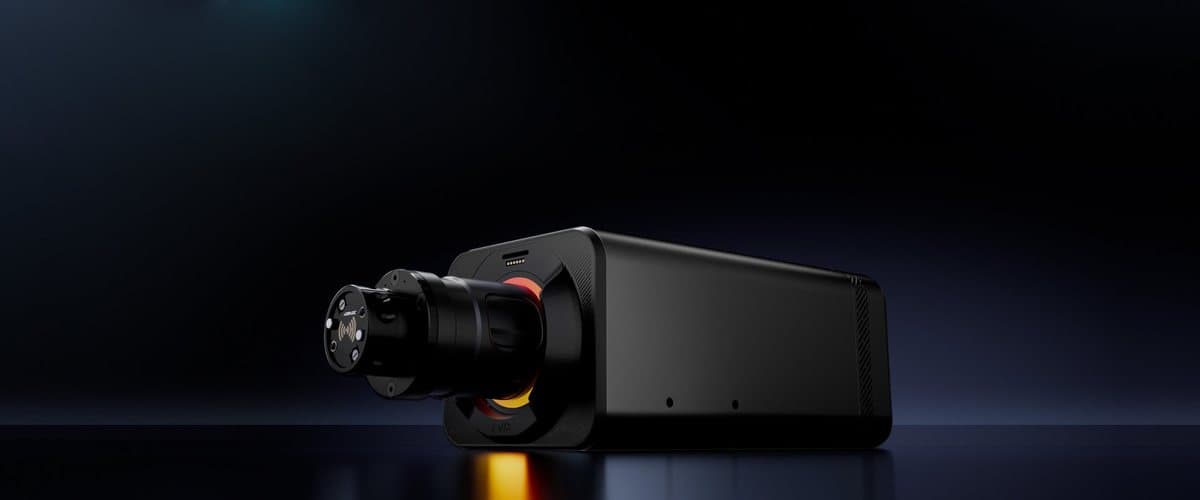
Direct Drive Won, and That Changes the Question
A few years ago the first decision was gear versus belt versus direct drive. That decision is over. In OverTake's 2025 community questionnaire of 615 sim racers, the brands that grew fastest were the ones selling affordable direct drive: MOZA went from barely registering in 2022 to 16.6% of respondents, and Simagic climbed from 2.3% to 10.7%, while Logitech fell from 38.4% to 20.7% and Thrustmaster from 26.6% to 14.6%. Fanatec held its lead at 28.8%.
The same survey shows where the money went. The $2,000 to $10,000 spending bracket grew from about 26% of respondents in 2022 to nearly half in 2025, and aluminum profile rigs overtook desk mounts as the most common mounting solution at 33.8%. People are building real simulators, not clamping a wheel to a computer desk.
So the question is no longer whether to go direct drive. It is which one, and that comes down to six specs.
The Six Things That Actually Decide How a Wheelbase Feels
1. Torque headroom not peak torque
Don't think of peak torque as a setting. Think of it as a ceiling.
The ceiling gives you headroom above whatever the sim is asking for, so the base is not clipping the peaks of the signal.
I've heard it said: a 15Nm base running close to 12Nm on a hot lap will clip more often than a 25Nm base running the same 12Nm. Clipping is what turns a detailed curb strike into a flat wall of force. You want enough headroom that it rarely happens, and not so much that you are driving at 30% power and losing resolution everywhere else.
2. Motor control and slew rate
Slew rate is how fast the motor can change torque, measured in newton meters per millisecond. It decides whether a curb strike feels like a hit or a shove, and whether you feel a slide start or feel it after it has started. The numbers are revealing once you look: across the current Simucube 3 line, Sport, Pro, and Ultimate are all rated at 9.5 Nm/ms, while the previous generation ran 4.8, 8.0, and 9.5 respectively. The 15Nm Sport now reaches the same response speed as the old 35Nm-class flagship. This is a difference you'll notice more than the torque gap (12Nm, 15, 20, etc).
3. Encoder resolution
The encoder reads shaft position. Higher resolution means finer detail reaching your hands, especially the small stuff: surface texture, the moment grip starts to go, tiny corrections at the limit. Current premium bases sit at 22 to 23-bit. Asetek's Invicta uses a 22-bit encoder resolving about 4 million steps per revolution. Entry bases run 14 to 15-bit, which is why a cheap 9Nm base and a premium 9Nm base do not feel the same at the same strength.
4. Thermal behavior
A spec sheet number means nothing if the base throttles twenty minutes into a stint. This is where the marketing gets slippery, because brands define torque differently. MOZA lists the R25 Ultra as sustained torque. Asetek defines its holding torque as up to 40 seconds continuously, which covers the worst sweeper you will find on any track (by a huge margin lol). If you race endurance, ask what the number means before you compare two of them.
5. Ecosystem and quick release
A wheelbase is a platform you will hang three or four steering wheels off over the next five years. What rims fit, whether the quick release has play in it, whether you can run a third-party formula wheel without stacking adapters, and whether the software is stable all matter more at year three than the torque number did at purchase. Simucube's current generation runs everything through a required Link Hub, which adds about $150 to the cost of entry and brings its own benefits in connection stability.
6. Platform
This is the hard constraint that kills most shortlists. Simagic, MOZA, Asetek, Simucube, and VRS are PC-only. Fanatec is the only brand with deep support across PlayStation and Xbox, and Logitech covers PlayStation and Xbox at the entry level. That is changing: MOZA is revealing its first PlayStation-compatible wheel at Tokyo Game Show, which runs September 17 to 21, 2026, which would make it the fifth manufacturer offering direct drive on PS5. If you race on a console and are not in a hurry, that announcement is worth waiting a week for.
Skip the spec sheets. Tell us what you race, where the rig is going, and what you want to spend, and we will build the shortlist for you.
Get My Custom Build Plan →How Much Torque Do You Actually Need?
Start with what the real cars pull. Fanatec's own engineering breakdown puts it this way: GT3 cars are typically capped at 6 to 8 Nm, though some drivers prefer settings closer to 10 to 12, and an LMP2 car has a reported 11 Nm limit at all tracks. Road cars with electronic power steering sit lower still. Open-wheel is the outlier, where a Formula 2 car can exceed 30 Nm.
Newton meters at the wheel. Grey bars are real cars, blue bars are wheelbase tiers. Real-car figures from Fanatec and BoxThisLap; wheelbase figures are manufacturer peak or sustained ratings.
Two things follow from that chart. First, a 12Nm base already matches or exceeds what a real GT3 driver feels, and GT racing is what 74.5% of surveyed sim racers say they drive most. Second, the very high torque bases are not about replicating a real car. They are about headroom, thermal margin, and the sharper response that usually comes packaged with a bigger motor.
Manufacturers are surprisingly candid about this. Logitech settled on 8Nm for the RS50 after analyzing their own product data, with 8 Nm described as the sweet spot between power and control. Reviewers who race daily tend to land a bit higher: one UK buyer's guide calls 10 to 16Nm the sweet spot for serious home sim racing, with enough headroom without the very high forces of 21 and 25Nm bases.
And a genuinely useful warning from a reviewer who tested MOZA's 21Nm flagship: most people do not drive anywhere near 21Nm, and at lower force feedback levels that base did not feel as responsive as some weaker, similarly priced competitors, including MOZA's own R12. Buying torque you will not use can actively cost you feel.
The Shortlist by Racer Type
Your first direct drive base
If you are coming off a Logitech G923 or a Thrustmaster belt wheel, almost any modern direct drive base will feel like a different hobby. The step from a gear-driven wheel to direct drive is the single biggest change you can make to how a sim feels, and it is bigger than every step above it combined.
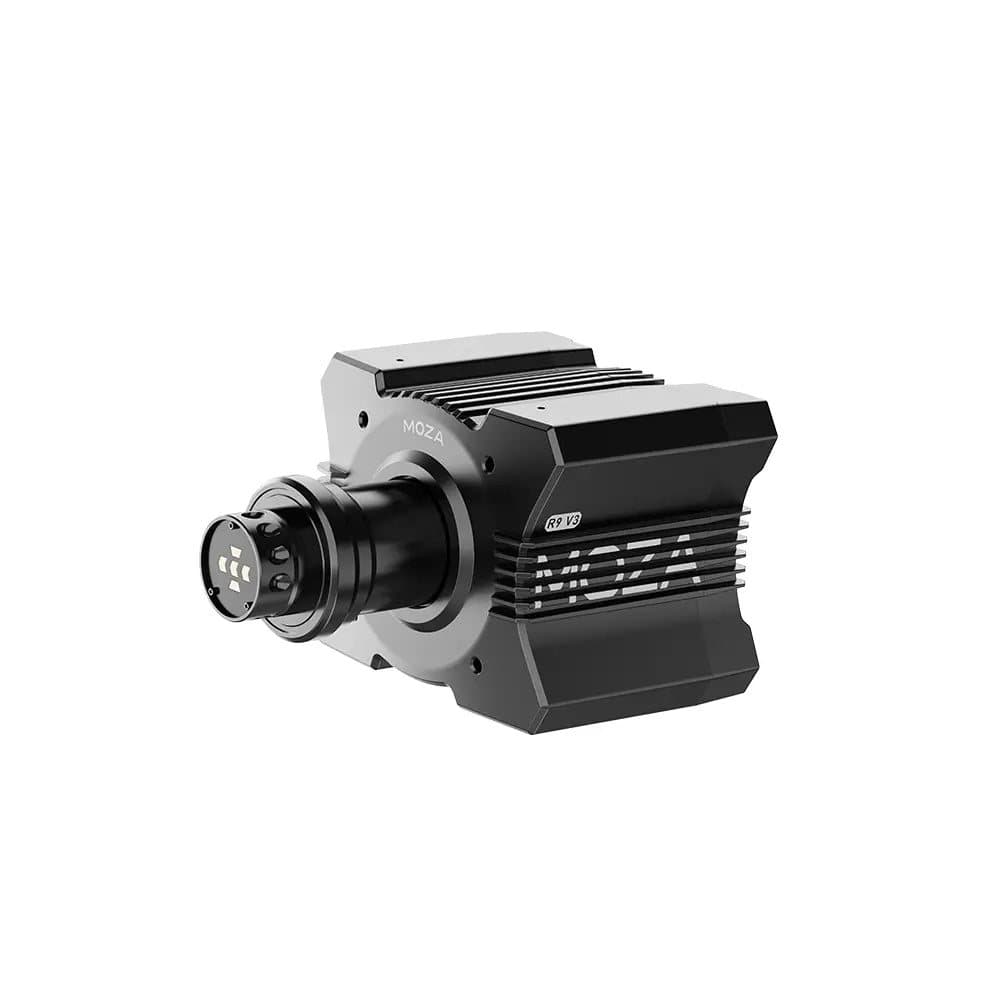
At this tier the value picks are the MOZA R9 V3 at 9Nm for $299 on sale, or the R12 V2 at 12Nm for $399, and the Simagic Alpha EVO Sport at 9Nm for $399. Asetek's Initium brings Danish build quality down to a 5.5Nm entry point in bundle form.
Our advice at this tier is to skip the very bottom rung. The gap between 5Nm and 12Nm in price is small, and 12Nm is a base you will not outgrow in a year. A useful data point on why the cheaper models are still good: a teardown of the Simagic line found that the Sport and Standard share the same processor, motherboard, and braking resistor, with the difference between them firmware-locked. You are buying a different output ceiling, not a cheaper machine.
The console racer
Console support narrows the field hard, and it is the first question we ask on any quote call.
PlayStation. The Fanatec Gran Turismo DD Pro at 8Nm is the established answer, now $599.99 after Fanatec's February 2026 price cuts, and it is officially licensed for Gran Turismo 7. The Logitech G RS50 undercuts it hard at $349.99 for the standalone 8Nm base, with TrueForce adding a layer of high-frequency detail nothing else at that price offers. If you want more torque on PlayStation, the 18Nm Fanatec ClubSport DD+ is the step up at $899.99.
Xbox. Fanatec is still the most complete answer here, with the CSL DD at $399.99 for 5Nm or $479.99 for 8Nm and the broadest catalog of Xbox-licensed rims. MOZA works on Xbox when paired with their ESX wheel.
One caution on all console setups: you are largely locked into that manufacturer's rims. That is fine if you like their catalog and frustrating if you do not.
The committed PC racer, 12 to 18Nm
This is where most of our customers land, and where the value in the current market is genuinely absurd. Three bases define the tier.
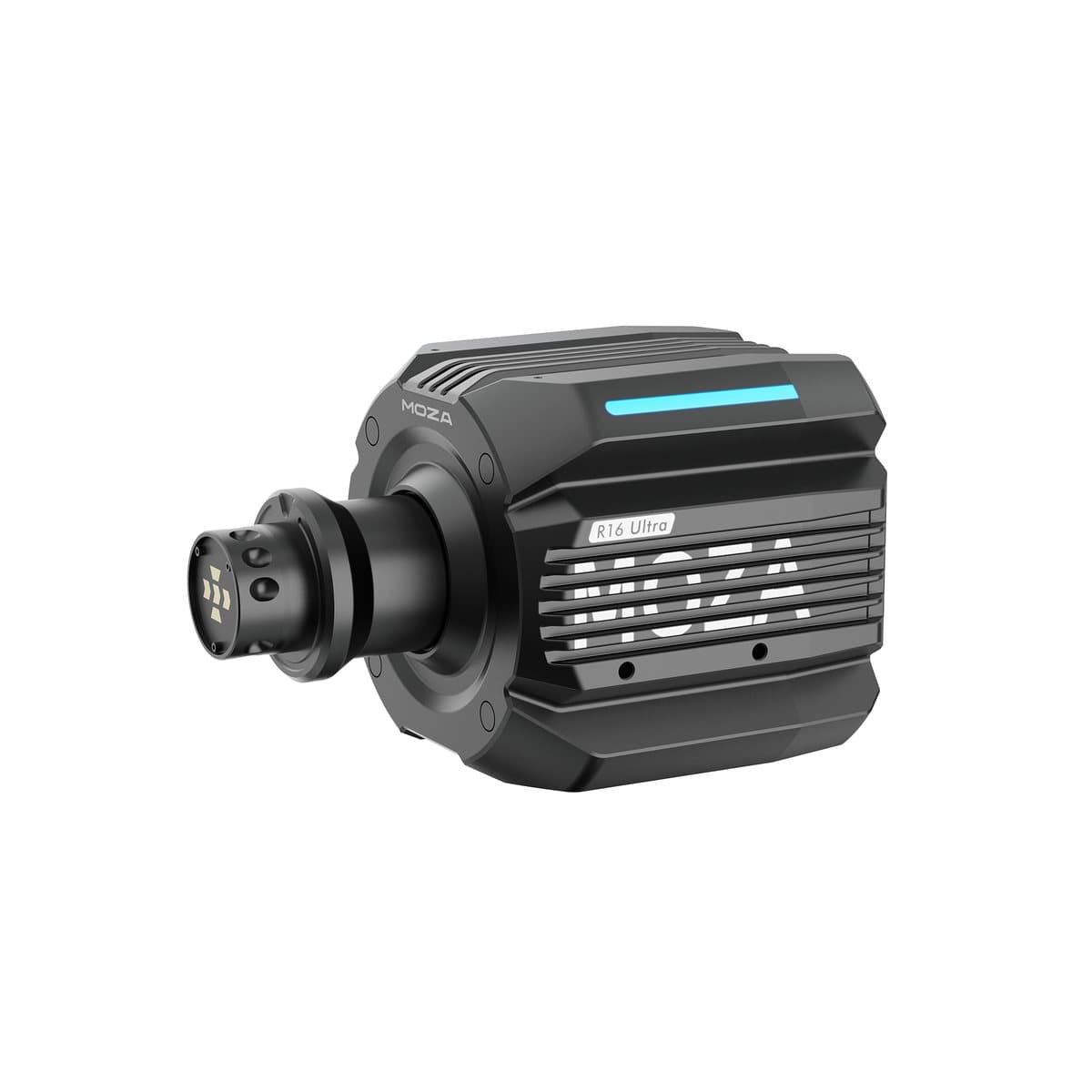
The Simagic Alpha EVO Pro delivers 18Nm for $699, which is the same torque as Asetek's Forte at $949.99 and Fanatec's ClubSport DD+ at $899.99, for hundreds less. Reviewers have handed the EVO line a perfect value rating and it earns it. The MOZA R16 Ultra at $529 is the other standout, using the newer Ultra-generation flat-wire motor in a package that costs only a little more than the 12Nm R12 V2. One reviewer called it the upgrade that stops the usual gradual climb through the R9 and R12.
Asetek's La Prima at 12Nm and $679.99 costs more per newton meter than either, and buys you an anodized extruded aluminum chassis and 22-bit encoder that genuinely feel a class above. It also takes a power supply upgrade that raises peak torque to 16Nm without replacing the base, which is a rare and sensible upgrade path.
If you race GT3 on iRacing or ACC, drive three to eight hours a week, and want one base for the next five years, this tier is the answer. It is also where we spec most builds in the $11,000 to $18,000 range.
We carry and build with Simucube, Simagic, MOZA, Asetek, Fanatec, and Heusinkveld, so the recommendation is based on your driving, not on what we happen to have in stock.
Spec My Wheelbase and Rig →The league and competition racer, 21 to 28Nm
Above 18Nm you are buying headroom, thermal margin, and build quality rather than usable strength. The bases are heavier, the power supplies are bigger, and the mounting requirements get serious.
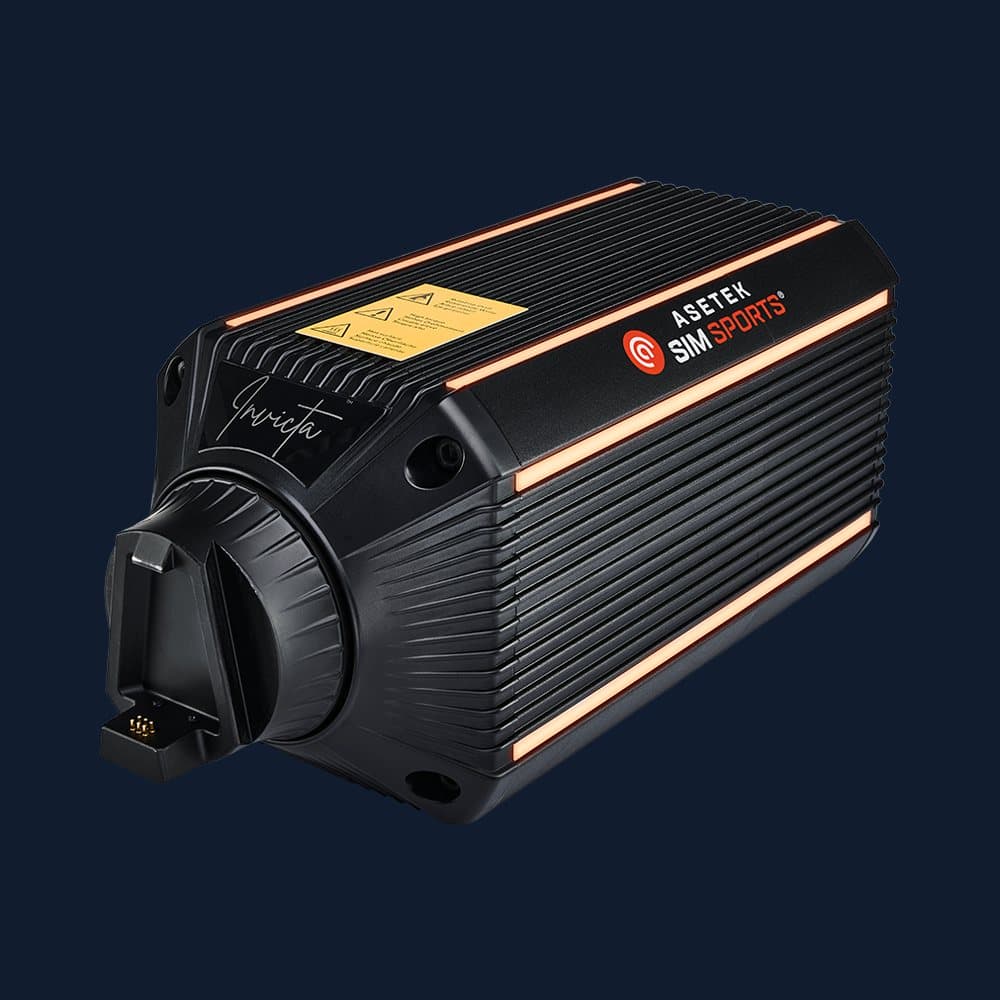
The value leader is the Simagic Alpha EVO Ultra at 28Nm for $969, which Simagic rates as continuous rather than peak and cools actively to hold it. MOZA's R25 Ultra is $899 for 25Nm sustained with a built-in torque sensor, and the R21 Ultra is $699. Fanatec's Podium DD sits at 25Nm for around $1,099 to $1,199. Asetek's Invicta is 27Nm at $1,349.99, which works out to roughly $50 per newton meter against the R25 Ultra's $36, and the difference you are paying for is chassis engineering rather than output.
Be honest with yourself before you buy into this tier. If you are going to run it at 45% strength because your forearms give out in an hour, a well-controlled 16 or 18Nm base will give you more detail for less money. The case for going here is real: endurance racers who want zero thermal drop across a three-hour stint, drivers running heavy formula rims that load the motor, and people who simply want the hardware to be the last thing that limits them.
The no-compromise build
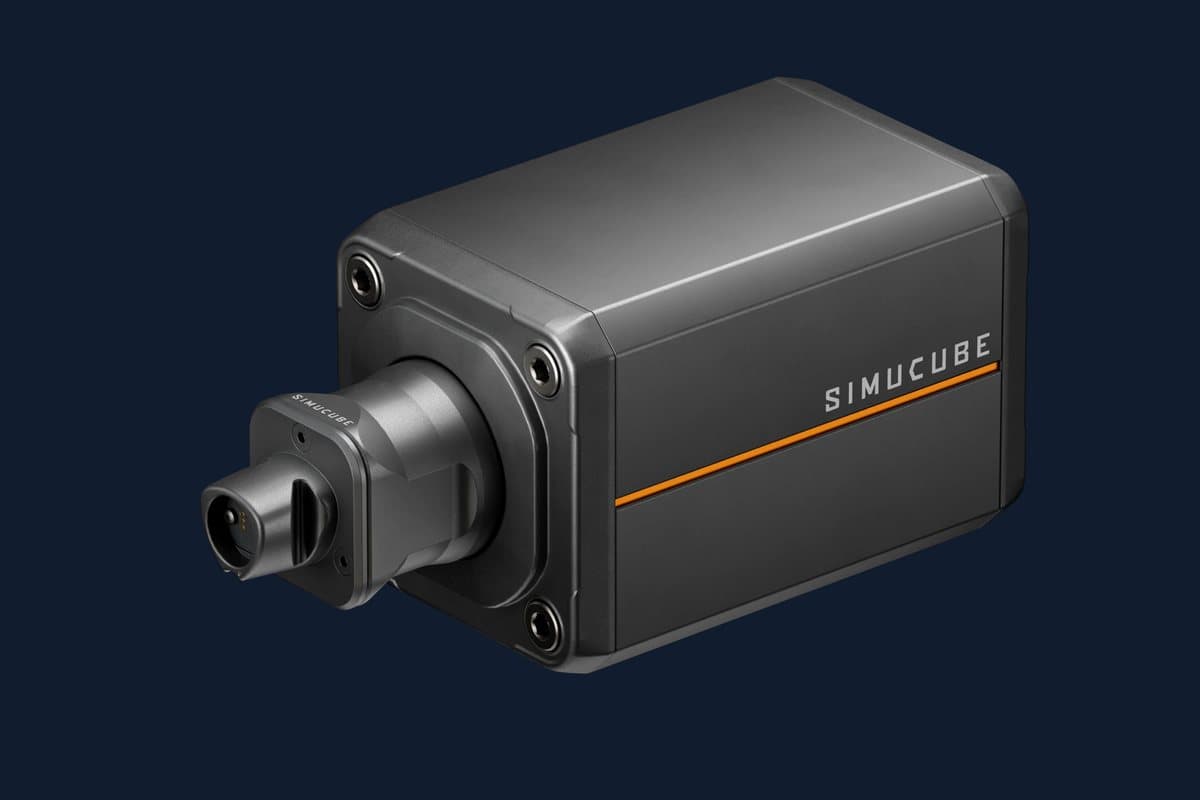
Simucube is the benchmark, and it is priced like one. The current line runs $1,399 for the 15Nm Sport, $1,599 for the 25Nm Pro, and $3,299 for the 35Nm Ultimate, before the required Link Hub at about $150 and the quick release at $169. Every model gets a 23-bit encoder, front and bottom mounting, and a three-year warranty, with five years on the Ultimate.
What you are buying is control quality rather than strength. Reviewers who tested all three concluded the range delivers the best overall force feedback quality they have experienced from any direct drive platform to date, while being direct that it is not the bang-for-buck choice. The honest framing from another review: the Pro is the answer for most people who go this route, not because the Sport feels worse, but because torque headroom matters.
The Ultimate at $3,299 is a different conversation. It uses a spoke-type IPM motor, the kind of design found in high-performance electric cars, and it is aimed at people for whom the price genuinely is not the deciding factor. On a $30,000-plus build with motion, it makes sense. On a $15,000 build it does not, and we will say so.
Rally and drift drivers
Rally and drift load a wheelbase differently than circuit racing. You are making large, fast steering inputs and asking the motor to reverse direction constantly, which puts slew rate and thermal behavior ahead of peak torque on the priority list. A base that holds a steady 12Nm through a long sweeper is not necessarily a base that snaps back cleanly during a countersteer.
Practically, that means favoring a well-controlled mid-torque base over a cheap high-torque one, and budgeting for a handbrake and a sequential shifter in the same breath. It also means the wheel rim matters more than usual, because a 320mm or larger round rim is what you want for drift and a 300mm formula rim is not. 24.2% of surveyed racers run a handbrake and 41.5% have an H-pattern shifter, and both numbers skew heavily toward this group.
Formula and open-wheel drivers
Open-wheel is the one discipline where the real cars genuinely pull higher torque than a mid-range base can produce, and where higher torque has a defensible case. It is also the discipline where a small, light formula rim changes the equation. A very sharp response profile that feels great with a heavy GT rim can feel nervous with a 280mm formula wheel, which is why the better bases let you dial the response down without removing the underlying capability.
Formula drivers should also budget differently. The wheel itself is a bigger line item, because formula rims with displays and full button arrays run $500 to $900 on their own and the wheel is where most of your inputs live.
The Full Pricing Picture
| Wheelbase | Torque | US Price | Platform | Best For |
|---|---|---|---|---|
| MOZA R9 V3 | 9 Nm | $299 (reg. $349) | PC, Xbox with ESX wheel | First direct drive |
| Logitech G RS50 | 8 Nm | $349.99 base | PS5, PS4, PC | Simplest PlayStation setup |
| Simagic Alpha EVO Sport | 9 Nm | $399 | PC | Entry with a real upgrade path |
| MOZA R12 V2 | 12 Nm | $399 (reg. $469) | PC | Best value first serious base |
| Fanatec CSL DD | 5 or 8 Nm | $399.99 / $479.99 | PC, Xbox | Xbox on a budget |
| MOZA R16 Ultra | 16 Nm | $529 | PC | Skipping a tier entirely |
| Simagic Alpha EVO | 12 Nm | $548 | PC | Mid-range sweet spot |
| Fanatec GT DD Pro | 8 Nm | $599.99 | PS5, PS4, PC | Gran Turismo 7 |
| Asetek La Prima | 12 Nm (16 upgraded) | $679.99 | PC | Build quality at mid torque |
| MOZA R21 Ultra | 21 Nm | $699 | PC | Most torque per dollar |
| Simagic Alpha EVO Pro | 18 Nm | $699 | PC | The value pick of the market |
| Fanatec ClubSport DD | 15 Nm | $699.99 | PC, Xbox | Xbox with real torque |
| Fanatec ClubSport DD+ | 18 Nm | $899.99 | PS5, PC | PlayStation plus PC in one base |
| MOZA R25 Ultra | 25 Nm sustained | $899 | PC | High torque with a torque sensor |
| Asetek Forte | 18 Nm | $949.99 | PC | Danish engineering at 18Nm |
| Simagic Alpha EVO Ultra | 28 Nm | $969 | PC | Flagship torque, sane price |
| Fanatec Podium DD | 25 Nm | ~$1,099–$1,199 | PC, Xbox | Fanatec ecosystem at the top |
| Asetek Invicta | 27 Nm | $1,349.99 | PC | Best-built base under $1,500 |
| Simucube 3 Sport | 15 Nm | $1,399 plus Link Hub | PC | Benchmark feel, lower torque |
| Simucube 3 Pro | 25 Nm | $1,599 plus Link Hub | PC | The reference for most builds |
| Simucube 3 Ultimate | 35 Nm | $3,299 | PC | No compromise, cost no object |
A note on the Fanatec figures. The ClubSport DD and ClubSport DD+ are listed above at 15 Nm and 18 Nm, the ratings that followed a 2026 firmware upgrade, up from the 12 Nm and 15 Nm figures published earlier in the year. Torque ratings can move with firmware, so confirm the current number before you cross-shop on it.
The Mistake That Costs People the Most Money
It is not buying the wrong torque. It is buying a wheelbase before deciding on the ecosystem around it.
Every base commits you to a quick release standard, a wheel catalog, a pedal ecosystem in some cases, and a piece of tuning software you will spend real hours inside. Switching later means selling the base and usually the rims with it. The specific traps we see most often:
- Buying a PC-only base when someone in the house races on PlayStation. There is no clean fix. Adapter boxes exist and they dilute the force feedback badly.
- Buying into a brand for one rim you like. Check the whole catalog, including what a formula wheel and a drift rim would cost you in that ecosystem.
- Forgetting the required extras. A Simucube 3 needs a Link Hub and a quick release on top of the base price. Asetek mounts are separate. These are not gotchas, but they are real money and they belong in the budget on day one.
- Ignoring the rig. This is the big one, covered next.
The Rig Matters More Than the Last 5Nm
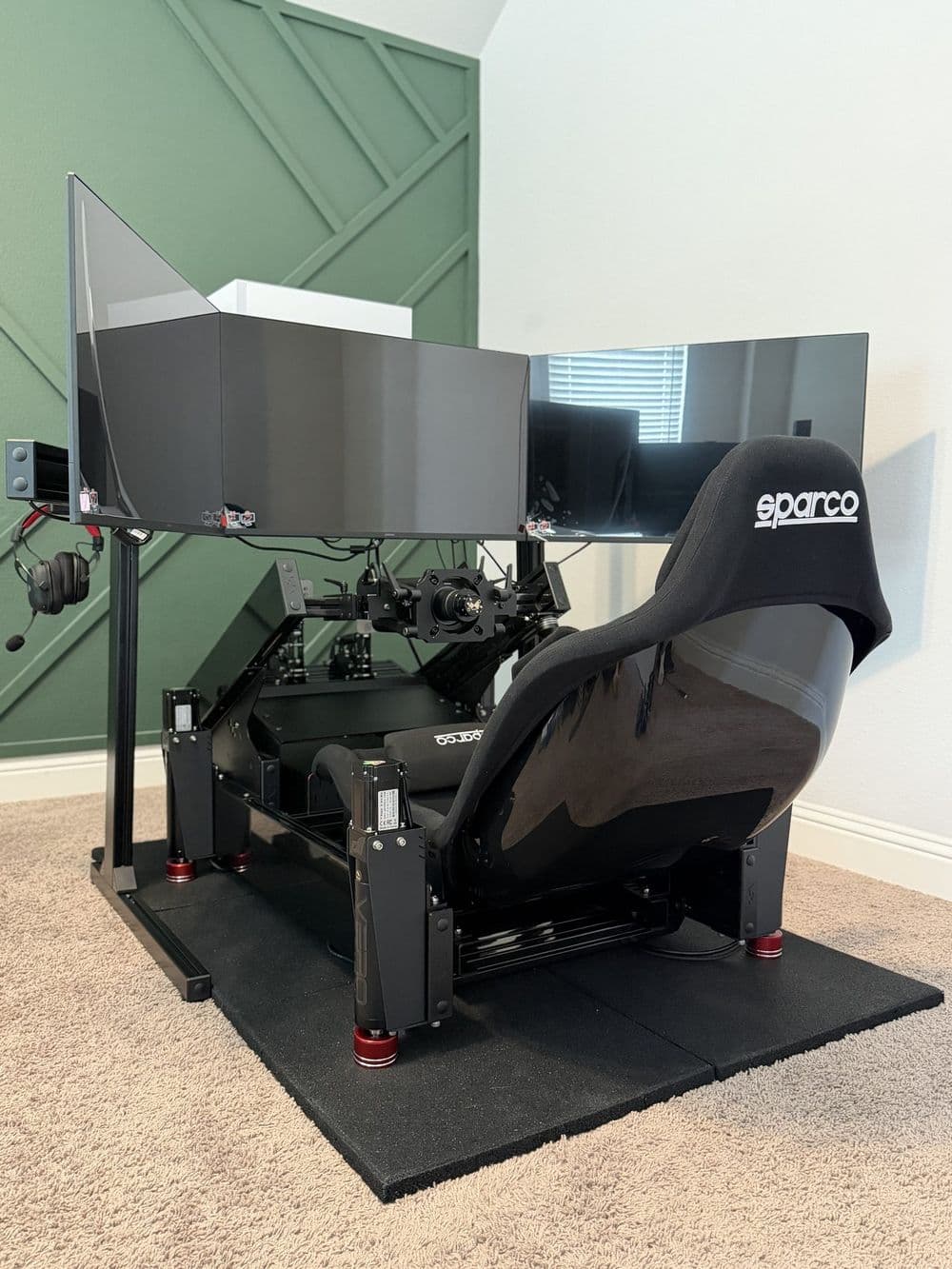
Direct drive bases are heavy and they push back hard. The MOZA R16 Ultra is 6kg, the Simucube 3 Pro is 11kg, the Simagic Alpha EVO Ultra is 11kg, and the Asetek Invicta is 11.3kg. Bolt any of them to a folding cockpit or a desk clamp and the frame becomes part of the force feedback signal. As one specialist retailer puts it, a rigid chassis and proper mounting options matter more as torque climbs, because flex eats detail.
That flex is why a 21Nm base on a wobbly frame can feel less precise than a 12Nm base on a stiff one. It is also why front mounting, where the base bolts to a plate through its face rather than sitting on its feet, is standard on serious builds. Every premium base supports it and most people never use it.
The practical rule we use when quoting: the wheelbase, the mount, and the chassis are one purchase. If a customer's budget forces a choice between a 28Nm base on an entry cockpit and an 18Nm base on a proper aluminum profile rig with a front-mounted wheel deck, we recommend the second one every time, and the customer is faster on it.
Every Track Vision build is spec'd as one system. We match the base to your discipline, mount it into a chassis built for that torque, calibrate the force feedback per title, and deliver it running. Builds start around $8,000, and full motion systems start at $20,000.
Start My Quote →What We Would Actually Build
Four configurations that cover most of the people who call us.
The first serious rig, around $8,000 to $9,000. A 12 to 16Nm base from MOZA or Simagic, a load cell pedal set, a GT rim, an aluminum profile chassis with a front-mounted wheel deck, a single large screen or a 45-inch ultrawide, and a PC sized to it. Nothing here is a compromise you will resent in two years.
The committed enthusiast, around $12,000 to $18,000. An 18Nm base, usually the Simagic Alpha EVO Pro or Asetek Forte, hydraulic or high-end load cell pedals, a second rim so you are not swapping hardware between disciplines, triple screens, and a properly integrated monitor mount. This is our most common build.
The competition rig, $20,000 and up. Simucube 3 Pro or Asetek Invicta, active or hydraulic pedals, triple OLED, a motion platform, and a chassis rated for all of it. At this level the wheelbase is no longer the limiting factor in your lap times, which is the entire point.
The commercial or multi-station install. Different priorities entirely: durability under strangers' hands, consistency between stations so lap times compare, and serviceability. We usually spec mid-to-high torque bases with strong warranty support and identical hardware across every station.
Frequently Asked Questions
Is more torque always better?
No. More headroom is better, up to the point where you stop using it. Past that you are paying for a ceiling you never touch, and some high-torque bases feel less responsive at the low force levels most people actually drive at. Match the torque to how hard you want the wheel to fight you, then spend the difference on pedals.
What torque should I run for GT3?
Real GT3 cars sit around 6 to 12 Nm at the wheel. Most sim racers land between 8 and 14 Nm in practice, which means a 12 to 18Nm base gives you the right feel with headroom left over for curb strikes and contact.
Do I need a Simucube to be competitive?
No. Simucube makes the most refined force feedback on the market and it is worth the money to people who value that specifically. It will not make you faster than a well-mounted Simagic or Asetek base. Mounting rigidity, pedal quality, and seat time all move your lap times more.
Can I use a MOZA or Simagic base on PlayStation?
Not natively today. Adapter boxes exist and they noticeably weaken the force feedback. MOZA is revealing its first PlayStation-compatible hardware at Tokyo Game Show in September 2026, so if you race on PS5 and can wait, that is worth watching.
How much of my simulator budget should the wheelbase be?
Roughly 15 to 25 percent on most builds. On a $12,000 rig that is a strong 18Nm base. Going much higher usually means underspending on pedals or the chassis, and both of those affect your driving more than the last few newton meters will.
Will my wheelbase be obsolete in three years?
The good ones are not. Direct drive motors do not degrade the way belt systems did, warranties run two to five years, and the main risk is ecosystem abandonment rather than hardware failure. Buying from a brand with an active software team and a broad rim catalog is the best protection available.
Still weighing three bases against each other? Send us your budget, your sim, and your space, and we will come back with a full build plan and a firm quote.
Request a Custom Simulator Quote →Pricing reflects US listings from MOZA, Simagic, Simucube, Asetek, Fanatec, and Logitech as of September 2026 and changes frequently, often by $100 or more during sale events. Torque ratings are manufacturer figures and are defined differently between brands. Sources are linked throughout.